
11 Best FuseBase alternatives for running your agency in 2026
FuseBase works for some teams, but the portal can feel limited as you grow. After testing dozens, these are the 11 best FuseBase alternatives I found in 2026.


Assembly, Moxo, and SuiteDash are some of the strongest FuseBase alternatives for service businesses, depending on how client-facing your workflows are. I researched and tested dozens to find the 11 best tools in 2026. I’ll cover what each tool does well, where it falls short, and who it's built for.
11 best FuseBase alternatives: At a glance
| 💻 Tool | 🎯 Best for | 🔥 Starting price (annual) |
|---|---|---|
| Assembly | Service firms that want a branded client portal platform with built-in CRM | $39/month |
| Moxo | Businesses that need structured client onboarding and approval workflows | $960/year |
| SuiteDash | Service businesses that want a white-label portal with deep customization | $180/year |
| HoneyBook | Freelancers who want a polished client booking flow | $29/month |
| Dubsado | Service businesses that want detailed, automated client intake workflows | $335/year |
| Plutio | Freelancers who want projects, billing, and client portals in one place | $190/year |
| Client Portal | Agencies that want a lightweight, no-frills portal for file sharing and communication | $25/month |
| Clinked | Teams that want a secure, branded client portal with file sharing and collaboration | $239/month |
| Bonsai | Freelancers who want contracts, time tracking, and invoicing in one place | $9/user/month |
| monday.com | Teams that want visual project tracking with flexible workflows | $12/seat/month |
| Asana | Teams that want structured task and project management across larger workloads | $10.99/user/month |
*Pricing correct as of June 2026. Verify with vendor.
Why look for FuseBase alternatives?
FuseBase works well for teams that want shared workspaces, client portals, and AI help in one place. But as your service business grows, a few limitations tend to surface:
- The learning curve can slow you down: Because FuseBase combines internal workspaces, client portals, and AI, it can take a while to get comfortable and set everything up the way you want.
- Billing and payments aren’t a core focus: Billing and payments features are there, but many firms will still lean on a dedicated billing tool for more advanced needs.
- Integrations are narrower than some agency tools: While FuseBase connects with staples like Zapier and Google Workspace, it still lacks the deep, native integration lists that larger platforms offer.
- The portal experience has a ceiling: You can white-label workspaces and portals, but if you need very custom layouts or highly tailored workflows per client, you may run into limits and rely on workarounds.
TL;DR: Which FuseBase alternative should you choose?
The right FuseBase alternative depends on how much of the client relationship you want to manage in one place and how important a branded experience is for your clients.
Choose:
- Assembly if you want a branded client portal platform with built-in CRM, dynamic client homepages, and automations, though it may be more than a very small team needs right away.
- Moxo if structured onboarding flows and approval-based workflows are your priority. It's built for process-heavy operations, so simpler teams may not need everything it offers.
- SuiteDash if you want a white-label portal with deep customization and business tools in one place. Setup takes time before it runs the way you want.
- HoneyBook if you're an independent service provider who wants proposals, contracts, and payments in one flow. It's less suited to teams managing multiple clients at scale.
- Dubsado if you want detailed, automated client intake workflows with full control over forms and sequences. Plan on a longer setup period before your workflows run smoothly.
Stick with FuseBase if you want shared workspaces, client portals, and AI tools in one place, and the combined internal and external experience is working well for your team.
1. Assembly: Best for service firms that want a branded client portal platform with built-in CRM
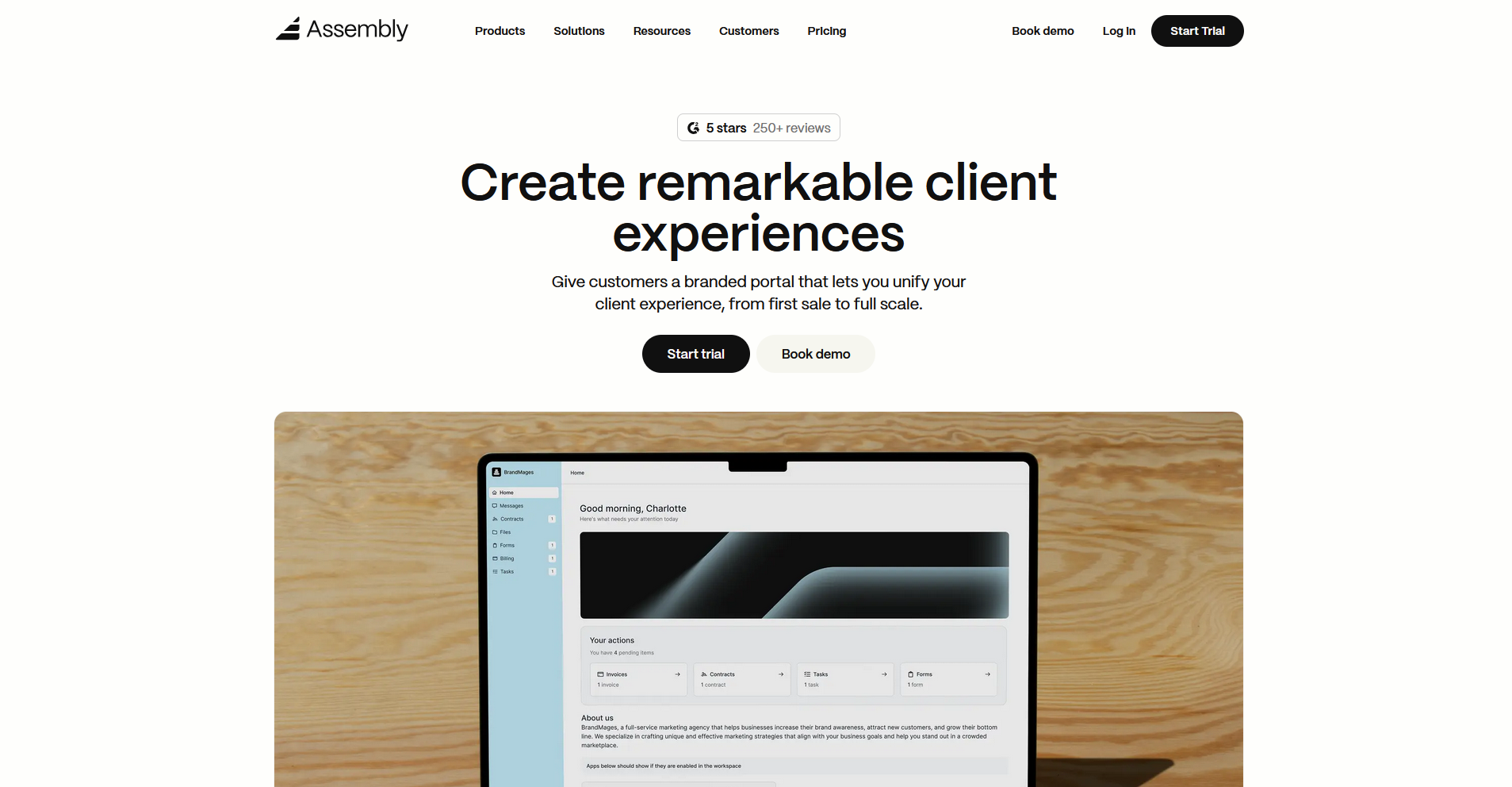
Assembly is a client portal platform built for professional service firms that want to manage client communication, billing, contracts, and onboarding in one branded workspace. It allows you to set up dynamic client homepages, consolidated payments, and recurring automations across your client base. Full white-label branding and compliance features like HIPAA are available on higher-tier plans.
Key features
- Dynamic client homepages: Display different portal content to different clients automatically based on custom field tags.
- Consolidated payments: Manage invoices, subscriptions, payment links, and payment analytics from a single billing view inside the portal.
- Recurring automations: Schedule time-based triggers for tasks, messages, and forms across your client base.
Pros
- ✅ Clients access a fully branded portal with a custom domain, so they never see Assembly's branding (on higher-tier plans)
- ✅ The built-in CRM keeps client notes, custom fields, files, and communication history in one place without a separate tool
- ✅The Assembly Assistant pulls in client notes, custom properties, and communication history to help with admin tasks and internal collaboration without leaving the platform
Cons
- ❌ The Starter plan supports only 1 internal user, which may push smaller teams onto a higher-tier plan sooner than expected
- ❌ Advanced features like HIPAA compliance, client access permissions, and custom branding removal require the Advanced plan
Best for
- Service firms that want a branded client portal with CRM, billing, and automations in one place
- Professional services teams that need dynamic, personalized portal experiences for multiple clients
- Growing firms that want to consolidate client communication, contracts, and payments without adding more tools
Pricing
Assembly starts at $39 per month.
2. Moxo: Best for businesses that need structured client onboarding and approval workflows
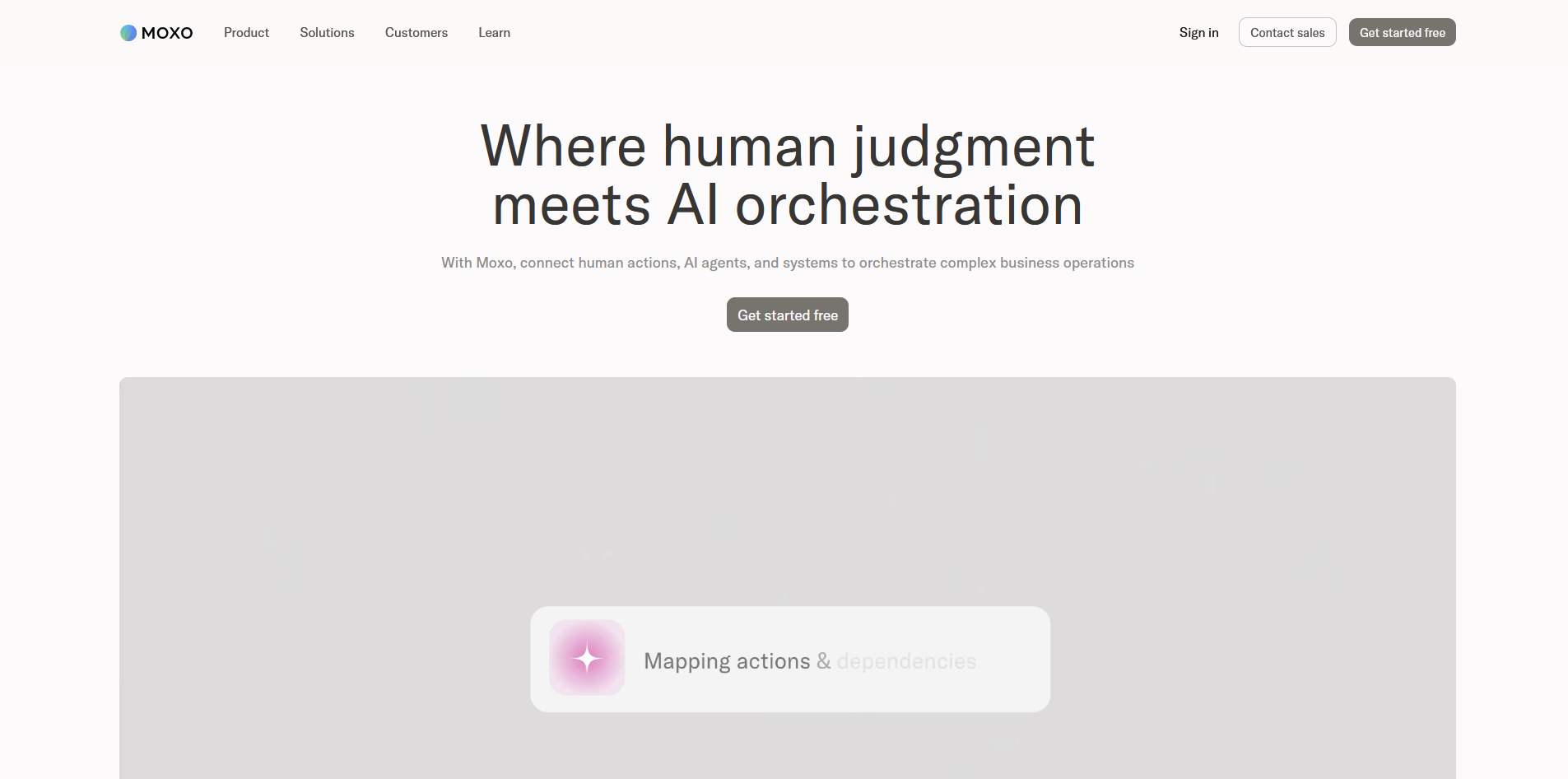
Moxo is a client collaboration platform built around structured workflows, secure messaging, and document handling for complex client processes. It works well for teams where formal approvals and documented handoffs are central to how work gets done. Teams with more open-ended or feedback-heavy projects may find the structured approach harder to work with.
💡Tip: Check out our full Moxo review to learn more.
Key features
- Workflow builder: Create multi-step client workflows with approvals, file requests, and eSignatures built into each stage.
- Secure messaging: Send and receive encrypted messages with clients and internal team members inside dedicated workspaces.
- Audit trails: Track every client interaction, document upload, and approval with a logged history across each engagement.
Pros
- ✅ The workflow templates make it possible to run consistent onboarding and approval processes across multiple client engagements
- ✅ Role-based permissions give teams control over what each client and team member can see and do inside their workspace
- ✅ Institutions in financial services, legal, and healthcare use Moxo for its compliance standards and documented client interactions
Cons
- ❌ The platform has a learning curve that can slow down initial setup, particularly for smaller teams without dedicated onboarding support
- ❌ Native billing and payment processing are not included, so teams that want invoicing built into their client portal will need a separate tool
Best for
- Businesses that run structured, multi-step client onboarding processes with formal approvals and document collection
- Teams in regulated industries like finance, legal, and healthcare that need documented client interactions and audit trails
- Operations-focused service firms where client work follows consistent, repeatable steps across engagements
Pricing
Moxo starts at $960 per year.
3. SuiteDash: Best for service businesses that want a white-label portal with deep customization
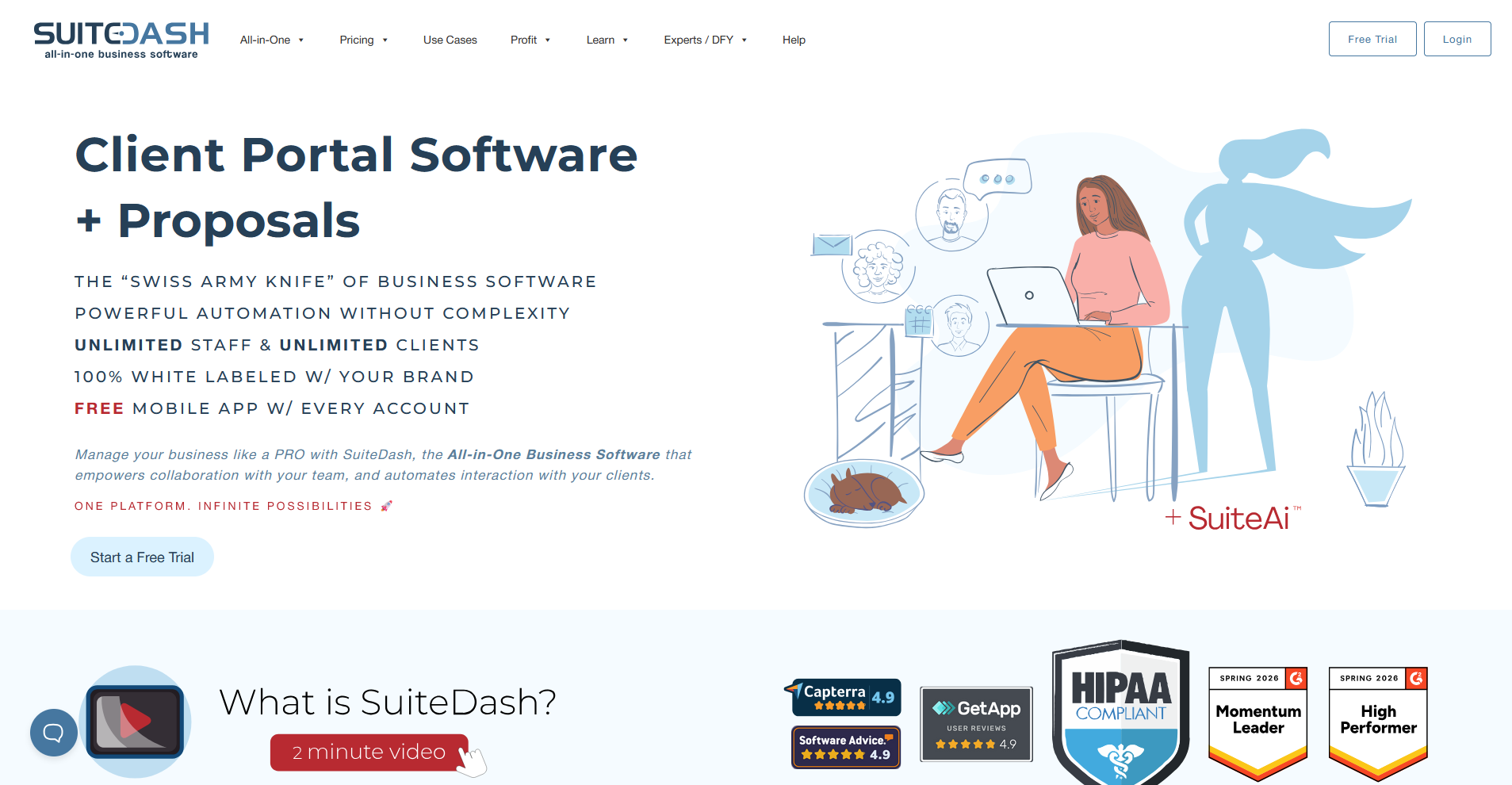
SuiteDash is a business management platform that combines a white-label client portal, CRM, project management, invoicing, and automation tools for service businesses. Flat-rate pricing covers unlimited team members and clients across all plans. The interface can feel cluttered, and getting everything configured the way you want takes significant time upfront.
💡Tip: Check out our full SuiteDash review to learn more.
Key features
- White-label client portal: Build a branded portal with a custom URL, a custom login page, and a branded mobile app for clients.
- Automation flows: Set up trigger-based workflows that connect CRM actions, billing events, onboarding steps, and project tasks.
- Flat-rate billing: Add unlimited team members and clients without paying per seat or per contact.
Pros
- ✅ The flat-rate pricing model means your costs don't increase as you add more team members or clients to the platform
- ✅ The platform covers the full client lifecycle, from proposals and contracts through project delivery, invoicing, and communication
- ✅ HIPAA-compliant hosting and 256-bit SSL make it a viable option for service businesses in healthcare-adjacent industries
Cons
- ❌ The interface is dense and takes considerable time to configure before it runs the way most teams need it to
- ❌ The built-in messaging experience relies on email-style communication rather than a real-time chat, which some teams find limiting
Best for
- Service businesses that want deep portal customization without paying per user or per client
- Growing teams that need CRM, project management, billing, and onboarding tools in one platform
- Businesses in regulated industries that need a HIPAA-compliant client portal infrastructure
Pricing
SuiteDash starts at $180 per year. Learn more in our full SuiteDash pricing guide.
4. HoneyBook: Best for freelancers who want a polished client booking flow
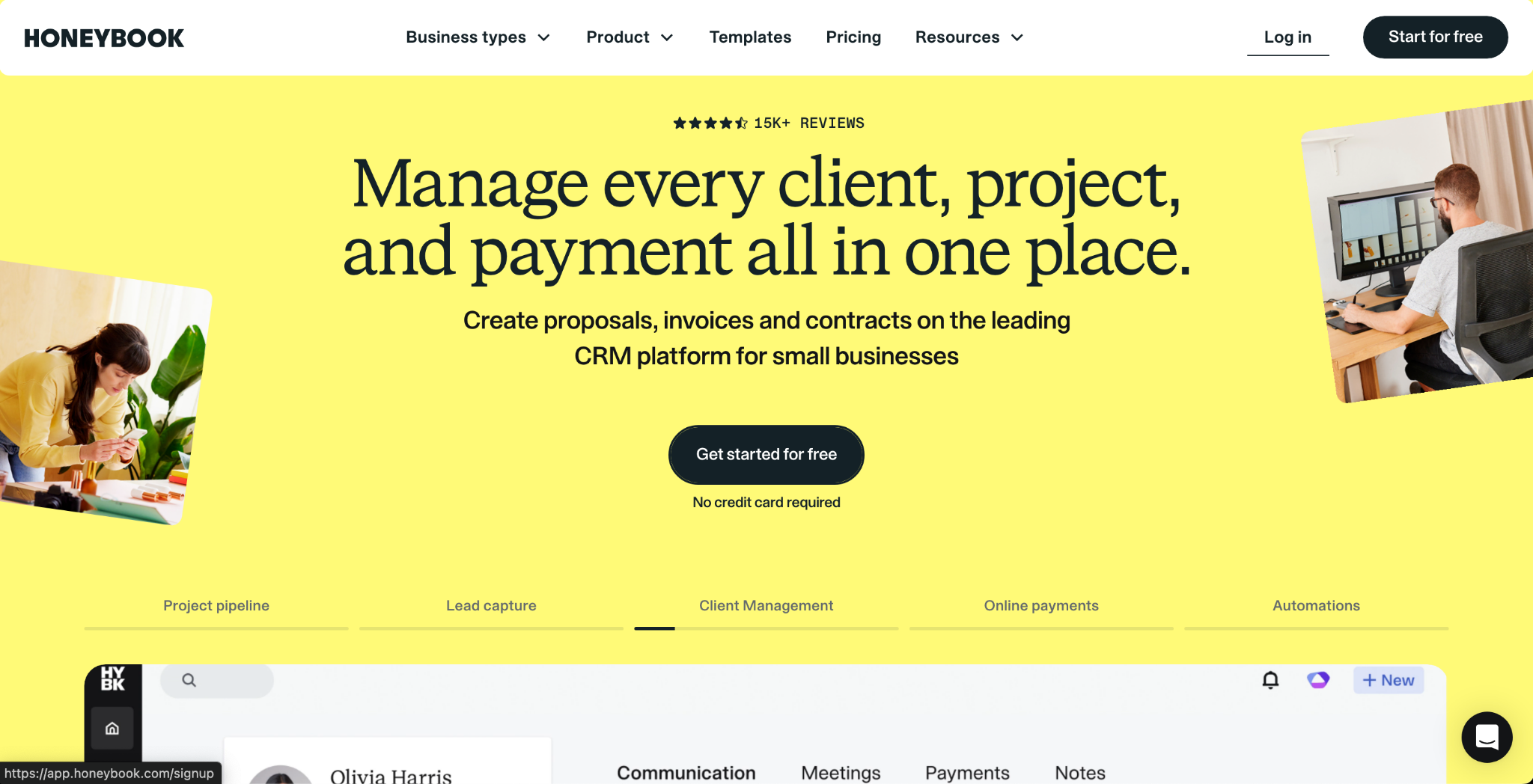
HoneyBook is a client management platform that connects proposals, contracts, invoicing, and payments into a single flow for freelancers and independent service providers. The branded templates help smaller operations look polished without extra design work. It's less suited to teams managing multiple clients at scale or businesses that need deep reporting and advanced CRM functionality.
💡Tip: Check out our full HoneyBook review to learn more.
Key features
- Proposal-to-payment flow: Send proposals, collect contract signatures, and process payments from a single client-facing link.
- Automated workflows: Build trigger-based sequences for follow-ups, reminders, and client communications after key actions.
- Client portal: Give clients one login to view messages, files, invoices, and contracts in a single dashboard.
Pros
- ✅ The proposal, contract, and invoice tools share the same data, so information doesn't need to be re-entered across steps
- ✅ The AI-powered automation builder lets you describe a workflow in plain language and generates the triggers for you
- ✅ Branded templates and a polished client portal help independent operators present a professional experience from the first touchpoint
Cons
- ❌ Reporting options stay fairly surface-level, so teams that need detailed revenue tracking or pipeline analytics will hit limits
- ❌ The mobile app has less functionality than the desktop version, which can be frustrating for teams that manage work on the go
Best for
- Freelancers and independent service providers who want proposals, contracts, and payments connected in one place
- Solo operators who handle client work from inquiry through final payment without a large team
- Creative professionals who want polished, branded client-facing documents without heavy manual setup
Pricing
HoneyBook starts at $29 per month.
5. Dubsado: Best for service businesses that want detailed, automated client intake workflows
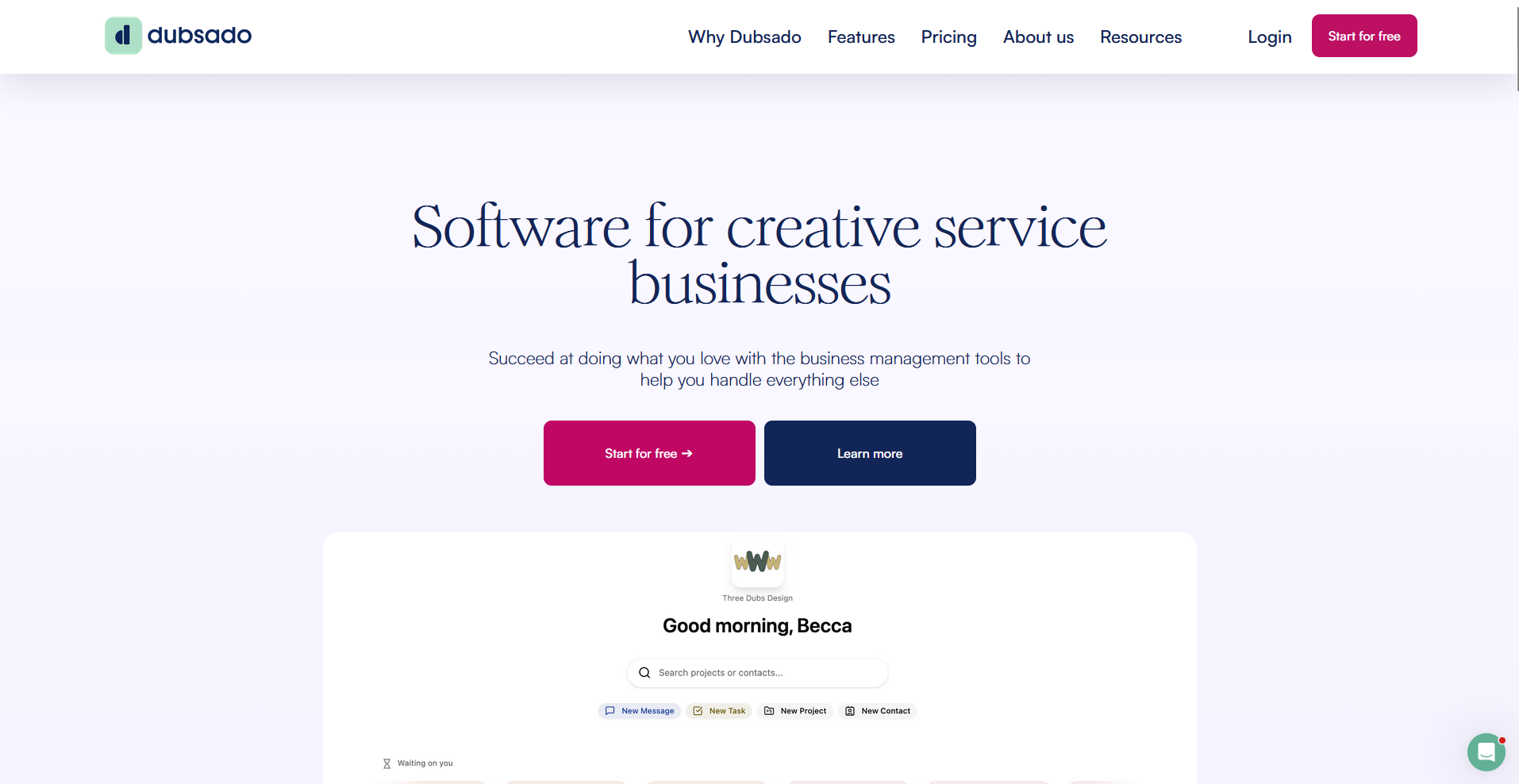
Dubsado is a CRM platform that covers proposals, contracts, invoicing, scheduling, and branded client portals in one place. The workflow automation is detailed and lets you build intake sequences that trigger off specific client actions and form responses using conditional logic. Project management thins out once onboarding ends, and many users bring in a separate tool to handle ongoing work.
💡Tip: Check out our full Dubsado review to learn more.
Key features
- Conditional forms and proposals: Build intake forms (and proposals where supported) with branching logic and conditional fields that adapt based on client responses.
- Workflow automation: Set trigger-based sequences that send emails, update project stages, and generate invoices after specific client actions.
- Branded client portal: Give clients a login to view contracts, invoices, forms, and project updates under your own branding.
Pros
- ✅ The forms and automation flows support conditional logic, which lets you tailor the intake experience to different client types
- ✅ Automation workflows cover the full client lifecycle from lead capture through payment, reducing manual follow-up work
- ✅ The client portal gives clients one place to sign contracts, pay invoices, and access files without back-and-forth emails
Cons
- ❌ Project management capabilities are limited after onboarding ends, with no Gantt charts, task dependencies, or expense tracking
- ❌ The workflow builder has a steep learning curve, and setting up complex automations takes considerable time to get right
Best for
- Freelancers and small service businesses that want detailed, customizable client intake workflows with automation
- Creative professionals who handle high volumes of proposals, contracts, and forms with varying requirements per client
- Independent operators who want a branded client portal without needing deep project management after onboarding
Pricing
Dubsado starts at $335 per year.
Special mentions
I tested each of these alongside the main picks, and depending on what you're looking for, they could be a better fit.
Here are 6 more FuseBase alternatives worth a look:
- Plutio: Plutio is a business management platform for freelancers and small agencies that keeps proposals, projects, invoices, and client portals under 1 roof. I liked that tracked hours can be pulled into invoices from the same workspace, even if complex billing still takes some manual setup.
- Client Portal: Client Portal is a WordPress plugin that gives clients a clean, password-protected space to access files and updates directly on your site. It's one of the more straightforward setups I tested for agencies already running on WordPress. Since it runs inside your WordPress install, security and plugin compatibility are on you to manage.
- Clinked: Clinked is a white-label client portal built around secure file sharing and group collaboration with detailed permission controls. It's well-suited to regulated industries like finance and legal, where access control matters more than flexibility. Teams that rely on many third-party tools may find the native integrations more limited than a broader business platform.
- Bonsai: Bonsai is a business management tool that covers contracts, invoicing, time tracking, and a basic client portal in one place. The contract templates are quick to use, and automated payment reminders work well for smaller teams. It can feel less suited to larger or more complex workflows, so it's worth testing the collaboration features before committing.
- monday.com: monday.com is a visual project management platform built around customizable boards. Tracking deliverables across multiple clients felt intuitive, and the variety of views gave me flexibility in how I organized work. It doesn't have a dedicated client portal, so clients join as guests on your boards rather than accessing a space built for them.
- Asana: Asana is a structured project management tool that handles complex task hierarchies and cross-team workflows well. For keeping larger internal teams organized across multiple projects, it held up reliably during testing. Like monday.com, it doesn't offer a branded client-facing portal, so the client experience stays inside Asana's own interface.
How to evaluate FuseBase alternatives
FuseBase alternatives vary widely, from lightweight client portals to broader platforms that combine workspaces, project management, and billing in one place.
The right fit depends on a few key factors:
- How client-facing your workflows are: Some tools are built primarily for internal teams, with clients accessing your workspace as guests. Others give clients a fully branded portal with their own login, custom domain, and tailored content. If the client experience is central to how your firm operates, it's worth looking past the feature list at what clients actually see when they log in.
- Whether you need billing included: A lot of platforms on this list handle collaboration and project management well, but stop short of invoicing and payments. If you want clients to receive invoices, pay, and track their billing history inside the same portal where they access their work, that narrows your options considerably.
- Internal user limits vs. client limits: These are 2 different pricing constraints, and they work differently across tools. Some platforms charge per internal team member, others charge based on how many clients you have, and some apply both. Getting clear on which constraint applies to your business can help you avoid surprises as you scale.
- The post-sale relationship: Many platforms focus heavily on onboarding and intake, but offer less structure for what happens after. It's worth considering whether you need task management, automated follow-ups, and ongoing communication in the same platform, or whether you're comfortable handling that elsewhere.
- How much setup you're willing to do: Some tools work out of the box with minimal configuration. Others offer deep customization, but can take weeks before they run the way you want. If you need something running quickly, that trade-off matters as much as the feature set.
The client experience your business delivers depends on the tools behind it
Many teams searching for FuseBase alternatives aren't just looking for a different workspace. They want something that handles more of the client relationship without stitching together a separate tool for every piece. The tools on this list take different approaches, and the right one depends on how much of that relationship you want to manage in one place.
If you're running a professional service firm and want a branded client portal platform that covers onboarding, billing, and ongoing client communication, Assembly is worth considering. Dynamic client homepages, recurring automations, and a built-in CRM can help you deliver a more consistent experience across every client relationship.
Start your free Assembly trial today.
Frequently asked questions
What is the best FuseBase alternative for service businesses?
Assembly, Moxo, and SuiteDash are among the strongest FuseBase alternatives for service businesses. Assembly covers branded portals, billing, and CRM in one place. Moxo suits teams that need structured onboarding and approvals, and SuiteDash works well for businesses that want deep customization.
What does FuseBase do?
FuseBase is an AI-powered collaboration platform that combines internal workspaces, client portals, project management, and document tools in one place. Teams use it to manage knowledge, run client-facing portals, and automate routine tasks through AI agents.
What happened to Nimbus Note?
Nimbus Note rebranded to FuseBase in 2023 after expanding beyond note-taking into a broader collaboration and client portal platform. The core note-taking functionality carried over, but the product now covers client portals, project management, and AI-powered automation.